Layout Preview | English Text | Translated Text |
| SciAps |
|
| ApNotes |
|
| February 2023 |
|
| Lithium Exploration |
|
| SciAps LIBS for Rapid Analysis of Lithium in Pegmatites and Nevada Claystones |
|
| Introduction |
|
| The world is increasingly reliant on lithium largely due to the rise of electric vehicles. With that, the price of lithium is also rising and the search for new sources of lithium ore has never been more important. SciAps makes lithium detection with a handheld instrument possible. The high resolution of the spectrometers combined with low detection limits for light elements makes the LIBS technique a powerful option to detect lithium and trace elements of first interest during mineral exploration, introducing advantages of portability and rapid analysis. |
|
| SciAps offers two LIBS analyzers that provide the world’s only handheld technique for directly measuring lithium in the field. SciAps Z-901 Lithium is a dedicated lithium-only analyzer, weighing only about 3.5 lbs. SciAps Z-903 provides the same great lithium performance, but with a wider spectral range and the added capability of seeing any element on the periodic table. This allows for the analysis of other important elements that can be used to aid in lithium exploration, such as potassium (K) and rubidium (Rb), which when ratioed as K/Rb have been showed to help determine whether a host pegmatite is barren or fertile in terms of lithium enrichment. |
|
| The two main sources of lithium are hard rock lithium mineral deposits and lithium brines. SciAps LIBS can be used to measure both solid and liquid samples. The most common rock type to host economic lithium concentrations is lithium-rich pegmatite, which can be found all over the world. Another rock type of interest recently in the U.S. has been claystone in Nevada, and there is gaining interest in exploration and mining for mineralization in this host rock. This application note details the SciAps factory-calibrated analysis for lithium in pegmatite and clays, utilizing lithium regions and regions for relevant base elements in the 350-675 nm range with Z-901 Lithium analyzer and the 190-950 nm range with Z-903. |
|
| Results |
|
| Method |
|
| SciAps Z-901 Lithium and Z-903 use a high-energy (~6mJ per pulse), pulsed laser to ablate sample material and create a plasma. Light emitted from the plasma is then captured by the optics and detection system within the device to collect a spectrum. Characteristic emission lines from each element create peaks in the spectrum, which can be interpreted to produce both qualitative and quantitative results. Lithium is one of the most sensitive elements for the SciAps LIBS analyzers, with a limit of detection less than 5 ppm in most solid sample types. |
|
| Whole rock pegmatite samples from northern Europe, southeastern U.S., Quebec, and Australia, representing a diverse and variable mineralogy from one locale to the next, were analyzed with the factory-provided Lithium Pegmatite calibration. Lithium claystone samples from Nevada were also analyzed using the SciAps Lithium Clay calibration. In order to achieve a more representative whole rock analysis, all samples were pulverized, homogenized, and pressed into pellets prior to analysis. Test times are less than five seconds. |
|
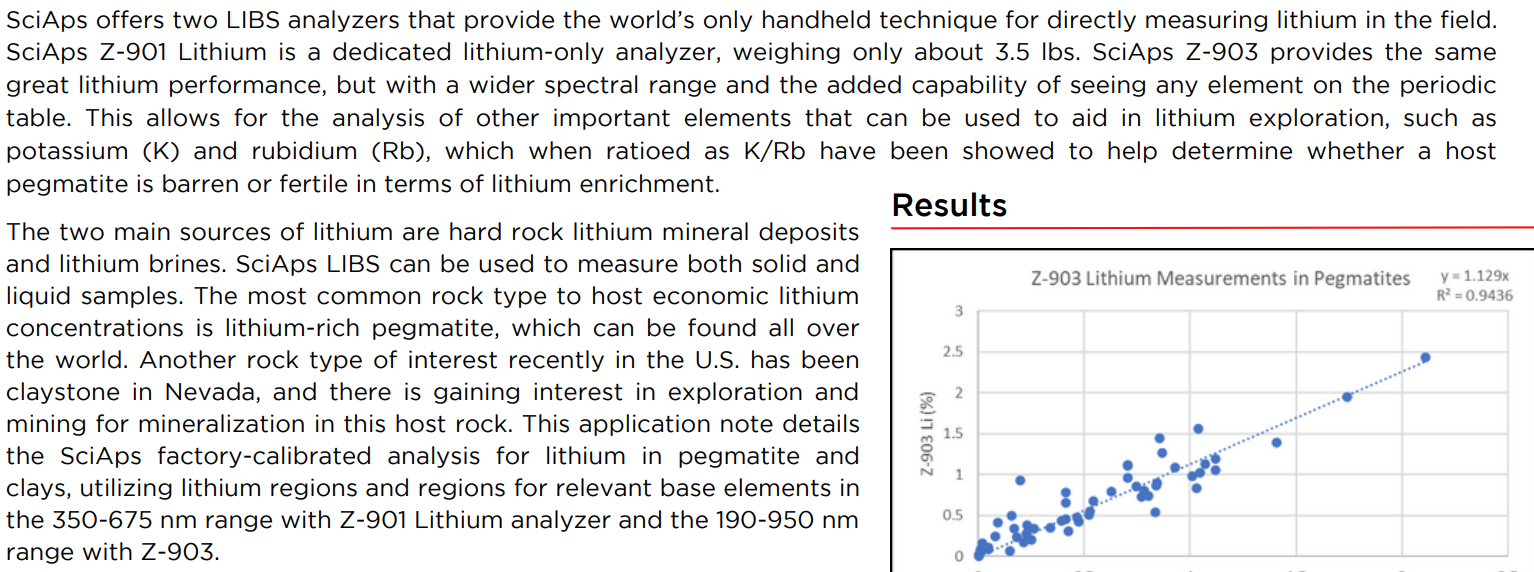
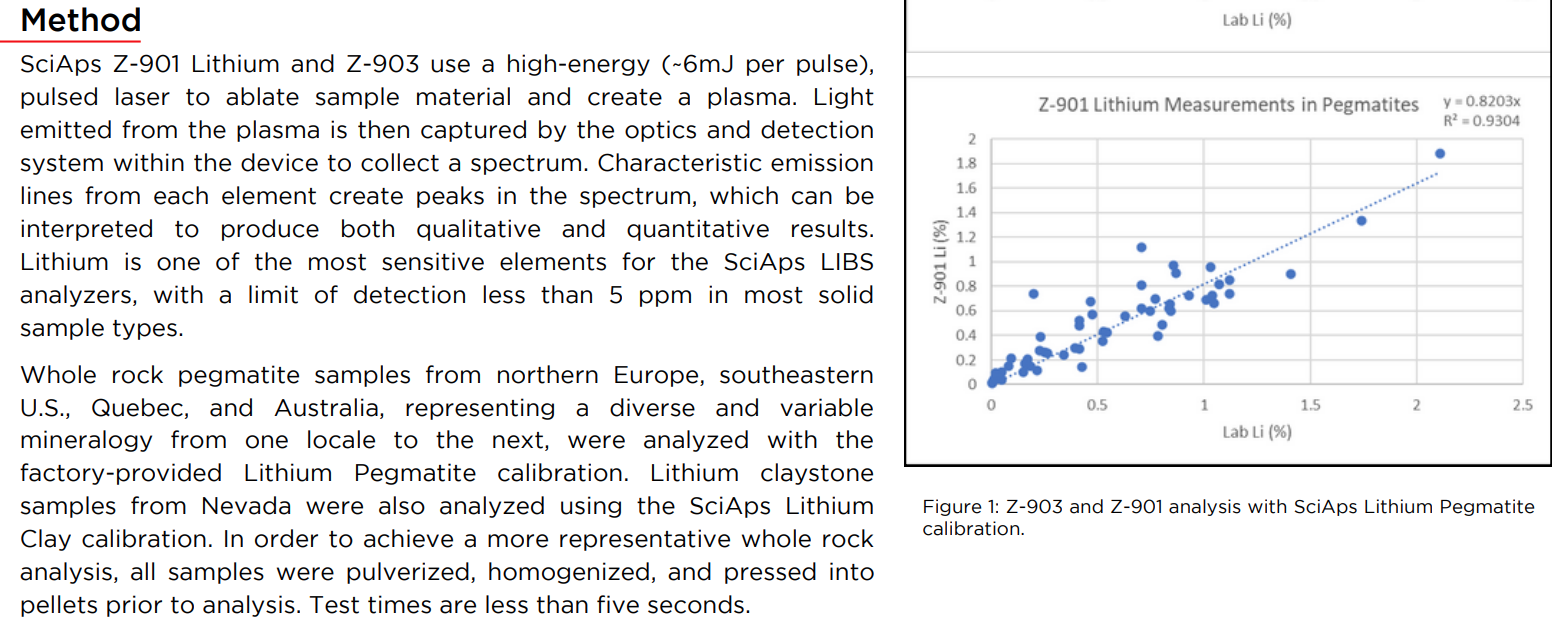
| Figure 1: Z-903 and Z-901 analysis with SciAps Lithium Pegmatite calibration. |
|
(BACK) |
|
|
| results cont'd |
|
| Shown in Figure 1, our handheld LIBS results on a diverse and variable set of pegmatite samples from multiple locations using the SciAps factory provided Lithium Pegmatite calibration. As with all the studies in this ApNote, each point represents a three-test average. The average results are plotted up against the lab assays showing correlation between the Z-901 Lithium or Z-903 and the lab. |
|
| For improved accuracy, it is possible to fine tune calibrations to optimize for a particular site-specific matrix to improve the quality of the geochemical analysis. Figure 2 shows results achieved after refining a calibration toward the GTA series of certified reference materials (CRMs) produced by Geostats, which are representative of pegmatite ore and spodumene concentrates from Western Australia. By targeting a more focused range of sample chemistry and grain size, and therefore limiting matrix effects, the LIBS accuracy can increase significantly. This is an example of how a site-specific calibration at a proposed mine site could enhance the performance of the LIBS over the already impressive factory-built calibrations. |
|
| Figure 2: Targeted analysis with a user-created, site-specific calibration. |
|
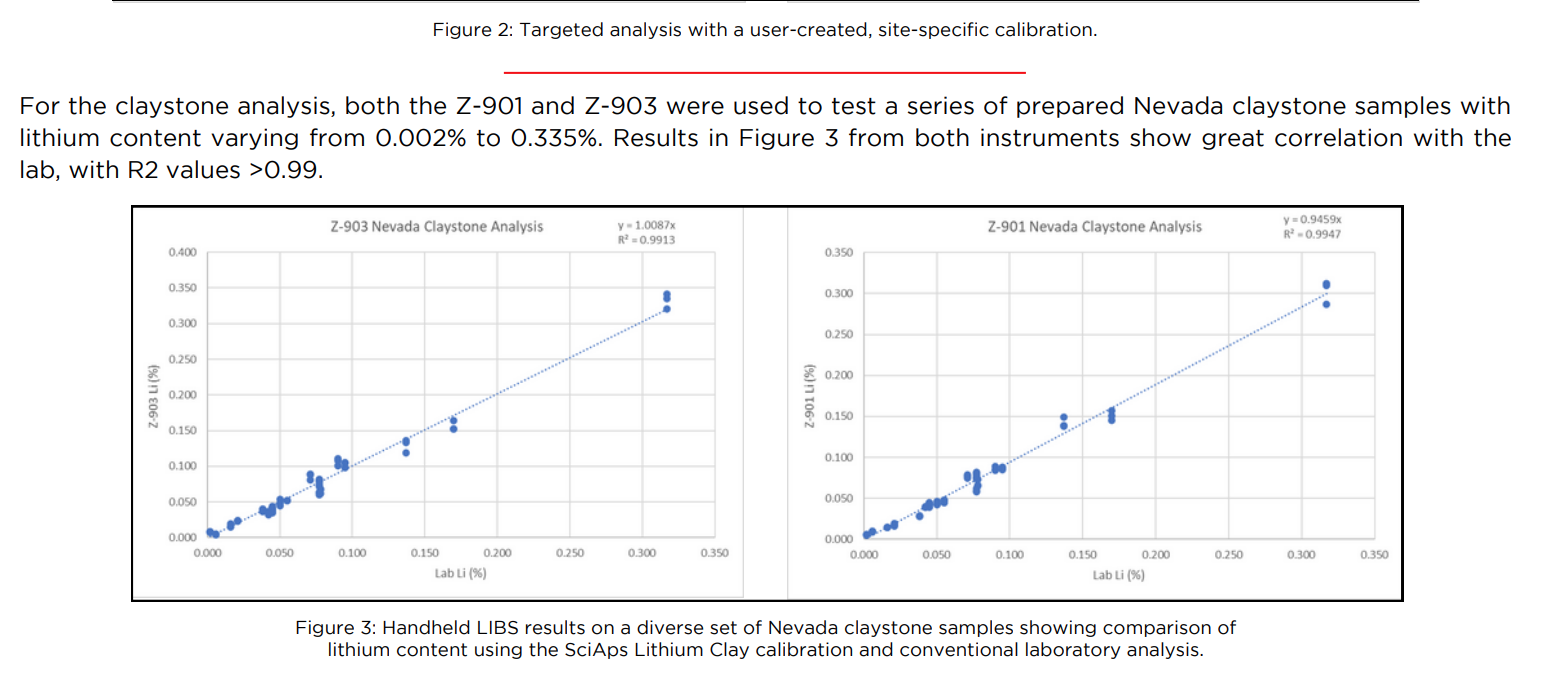
| For the claystone analysis, both the Z-901 and Z-903 were used to test a series of prepared Nevada claystone samples with lithium content varying from 0.002% to 0.335%. Results in Figure 3 from both instruments show great correlation with the lab, with R2 values >0.99. |
|
| Figure 3: Handheld LIBS results on a diverse set of Nevada claystone samples showing comparison of lithium content using the SciAps Lithium Clay calibration and conventional laboratory analysis. |
|
| Conclusion |
|
| Handheld LIBS can be used to quickly and accurately analyze lithium and other elements in the field. SciAps Z-901 Lithium is a lighter weight, dedicated lithium-only analyzer, while Z-903 provides great lithium performance with a wider spectral range and the added capability of seeing any element on the periodic table allowing geoscientists to deduce many important mineralogical associations. SciAps LIBS relies on empirically-built calibrations. Factory-supplied pegmatite and clay calibrations can be effective and robust, with sample preparation bring key to achieving optimal precision and accuracy when using this instrumentation. For improved performance, site-specific calibrations also can be built. Labs may take weeks or months, but LIBS provides instant result that allow geologists the information they need to move quickly and make decision, when every day spent in the field matters. |
|
| References |
|
| Wise, M.A.; Harmon, R.S.; Curry, A.; Jennings M.; Grimac, Z.; Khashchevskaya, D. Handheld LIBS for Li Exploration: An Example from the Carolina Tin-Spodumene Belt, USA. Minerals 2022, 12, 77. https://doi.org/10.3390/min12010077 |
|
| Dessemond, C.; Lajoie-Leroux, F.; Soucy, G.; Laroche, N.; Magnan, J.-F. Spodumene: The Lithium Market, Resources and Processes, Minerals 2019, 9, 334. https://doi.org/10.3390/min9060334 |
|
| If applicable, please add: LOCAL COMPANY NAME LOCAL WEBSITE LOCAL PHONE |
|